
REMEMBRANCE DAY – The Thornhams Memorial
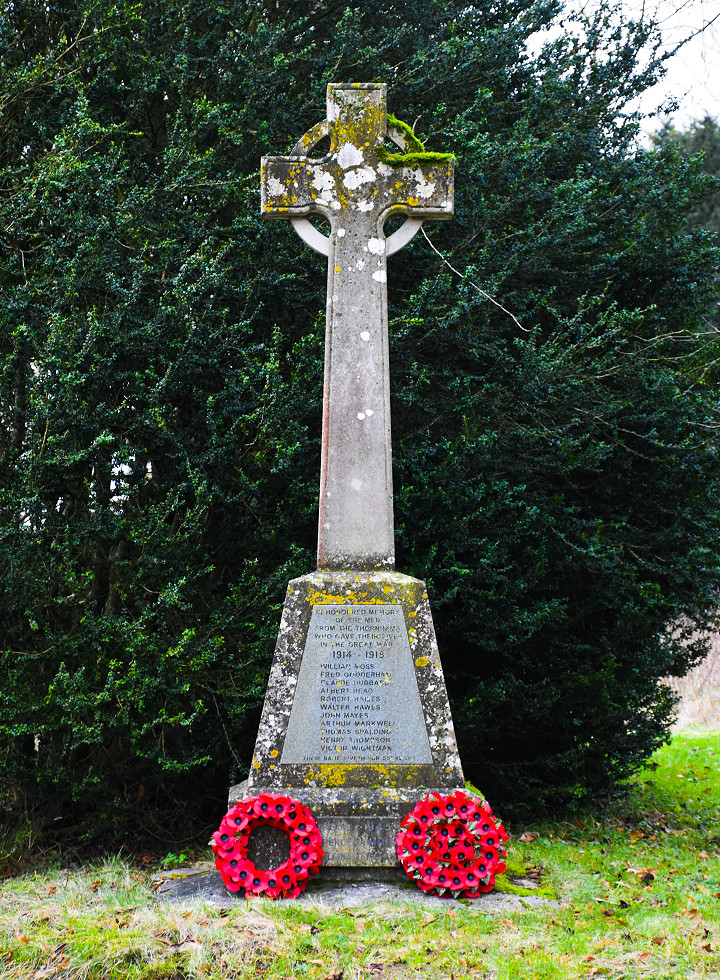
As we approach this year’s Remembrance Sunday, the cover photograph of the Thornham Magna war memorial offers a fitting focus for our reflection.
This imposing Celtic Cross, at the entrance to the churchyard of St Mary Magdalene Church, pays permanent tribute to the men of both Thornham villages who made the ultimate sacrifice. At this time of year, when the vibrant autumnal colours start to give way to the onset of winter, the woodland surroundings make a particularly poignant backdrop, accentuating the wreath of bright-red poppies adorning the memorial.
Created from Portland Stone, the memorial lists the names of thirteen men from The Thornhams that gave their lives: eleven in the 1914-18 war, and two during the Second World War. This list, covering both parishes, is repeated on the carved wooden Roll of Honour inside the church at Thornham Parva. Each memorial also features the tribute ‘Their name liveth for evermore’ – biblical words brought to the country’s cenotaphs by Rudyard Kipling, who himself lost his only son in the Battle of Loos in 1915.
Several months earlier, on 8th May 1915, The Thornhams had lost two of its sons on the same day, in the Second Battle of Ypres in Belgium. That day saw the Suffolk Regiment face a particularly ferocious onslaught at Frezenberg Ridge; the bodies of Albert Head and Arthur Markwell were never found, and they are now commemorated on the Menin Gate in Ypres – along with Walter Hawes, killed on the opening day of the Battle of Passchendaele in 1917.
Although most of The Thornhams’ Great War losses were on the Western Front, one of its sons lies further afield. Claude Hubbard, who was a gamekeeper’s assistant back home, is buried in the Cairo War Memorial Cemetery, having died in May 1916, most likely in operations in Egypt or Palestine.
The villages’ sacrifices continued through to the end of the Great War. Victor Wightman, aged 19, son of Robert and Alice Wightman, was killed in the Somme area of France in April 1918 repulsing the Germans’ final push for victory. Grieving families were invited to have an epitaph carved on the headstone; Victor’s sister, Florence, arranged for his to read in perpetuity: “Passed Beyond the Cannon’s Roar but Not Beyond Love”.
Tragically, the two villages suffered their final loss of the Great War after the Armistice had been signed. John Mayes - a farm labourer and husband of Eliza Mayes of Water Lane, Thornham Magna - was accidentally killed in Belgium in December 1918 in the aftermath of the fighting, leaving three children, the youngest of which, Reginald Mayes, was born in 1915.
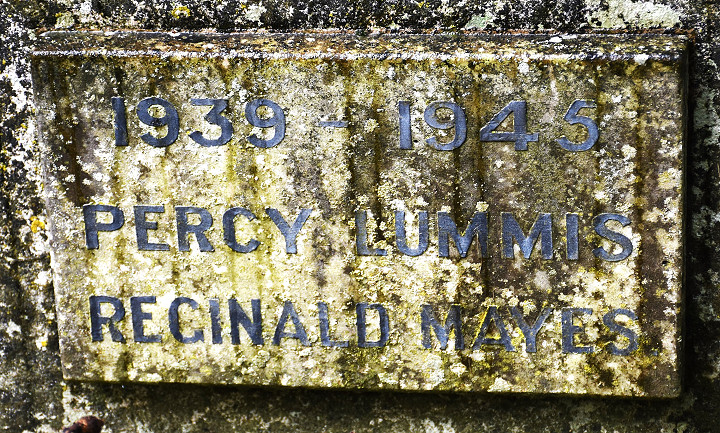
If you look at the base of the war memorial, you will see an additional plaque bearing the names of the two Thornham men killed in the Second World War, Percy Lummis and Reginald Mayes. The sad fact that Mayes father-and-son are both listed on the memorial reinforces the impression that war must have had a very long-lasting effect on our local community. Reginald Mayes died in September 1943 on the Burma Railway, two years after his marriage to Annie Talbot. He is buried in Kanchanaburi War Cemetery in modern-day Thailand, where 5,000 other Commonwealth casualties are also buried or commemorated. His headstone bears the simple inscription, “That your sacrifice shall not be in vain. Peace be with you.” The Thornham Magna Celtic Cross war memorial was unveiled and dedicated in August 1921, having been sponsored by Charles Henniker-Major, the sixth Lord Henniker. It was erected by Messrs J Cooley and Son of Diss, at a cost of around £60, which was raised entirely by public donations. Colonel Lord Henniker had himself served in the First World War, as a major and later as lieutenant colonel in the Rifle Brigade. He had taken his battalion to France at the outbreak of war in 1914 and was involved in the great battles of the Somme and Ypres among others. He was of course deeply affected the war and his sponsorship and attendance at the unveiling ceremony must have been a highly emotional occasion for everyone present, reflecting the collective grief and remembrance of the community for their lost sons. For our tomorrows, they gave their today. GC